

· 4 min read
Reading the pulse: an old practice, a new instrument
For more than two thousand years, people have pressed a fingertip to the wrist and paid attention. The instruments keep changing. The question has not.
Place two fingers on the inside of your wrist and wait. Something answers: quick or slow, full or faint, steady or a little uneven. For more than two thousand years, people in many places have learned to read that answer. The instruments keep changing. The question has not: what is this body saying today?
A clock made of water
In Alexandria, early in the third century BCE, the physician Herophilus approached the pulse as something to measure. According to a treatise by the physician Marcellinus, probably written in the second century CE, Herophilus timed pulses with a water clock. He counted beats while it ran and noted how far a patient's pulse ran ahead of the usual for their age. No other ancient author mentions the clock, so the detail deserves a light touch (Lewis, 2015). Herophilus is also said to have compared the pulse's rhythm to musical meter (Ghasemzadeh and Zafari, 2011).
More than four centuries later, Galen of Pergamon devoted a sixteen-book work to the pulse: four treatises of four books each, on its kinds, how to tell them apart, their causes and what they foretell (Lewis, 2024). Physicians of the medieval Islamic world, Ibn Sina among them, built on this Greek scheme and refined it (Ghasemzadeh and Zafari, 2011).
Three fingers at the wrist
Pulse reading took root in many traditions, each with its own vocabulary. In Ayurveda, the pulse leads the classic eightfold examination of the body (Ghasemzadeh and Zafari, 2011). Reading it is called nadi pariksha. The practitioner rests three fingertips along the artery at the wrist. Each finger is said to sense a different quality, read through the three doshas: vata, pitta and kapha (Kumar et al., 2019).
The traditions disagree on much. They share a habit: attend to the pulse closely and over time, and read its character as information. Pace was never the whole story.
The pulse on paper
Fingers are sensitive, but they leave no record. In 1860 the French physiologist Étienne-Jules Marey revised an earlier instrument, the sphygmometer, and introduced a sphygmograph. It rested on the artery at the wrist and drew each beat as a line on paper (Ghasemzadeh and Zafari, 2011). A pulse could now be kept, compared and shared, and its form could be seen: a rise, a peak, a small notch and a softer wave after it.
Light on the skin
In 1937 Alrick Hertzman, a physiologist at Saint Louis University, described a photoelectric plethysmograph. A small lamp lit the skin of a finger or toe, and a photoelectric cell caught the light scattered back, which rose and fell slightly as blood volume changed with each beat (Hertzman, 1937; Quaresima et al., 2024). Nothing pressed on the artery. Light did the feeling. Now called photoplethysmography, or PPG, the method is simple and low-cost (Allen, 2007). It is a key sensing technology in today's smartwatches and fitness trackers (Charlton et al., 2023).
In the early 1970s the Japanese engineer Takuo Aoyagi was trying to measure the heart's output with a dye and an ear sensor, and the pulse kept disturbing his readings. He tried to cancel it out, and noticed the cancellation failed whenever the blood's oxygen level changed. That failure was the clue. By comparing how pulsing blood absorbed red and infrared light, he could estimate how much oxygen it carried. He presented the idea in 1974. Pulse oximetry is now routine in hospitals worldwide (Severinghaus, 2007; Quaresima et al., 2024).
A ring, a night, a model
A ring sits on the finger, where Hertzman began, and can stay there through the night while the body is quiet. In a study of 49 adults, nightly heart rate and heart rate variability from a commercial smart ring agreed closely with a medical-grade ECG (Kinnunen et al., 2020). Researchers say wearable PPG has the potential to provide much more information on health and wellbeing than heart rate and rhythm alone (Charlton et al., 2023).
Machine learning is one way to search for that information at scale. Researchers at Apple trained models on unlabeled pulse (PPG) and heart (ECG) recordings from the Apple Watches of about 141,000 people. Without being told what to look for, the models learned patterns that carried information about a person's age and health (Abbaspourazad et al., 2024).
Where Mere fits
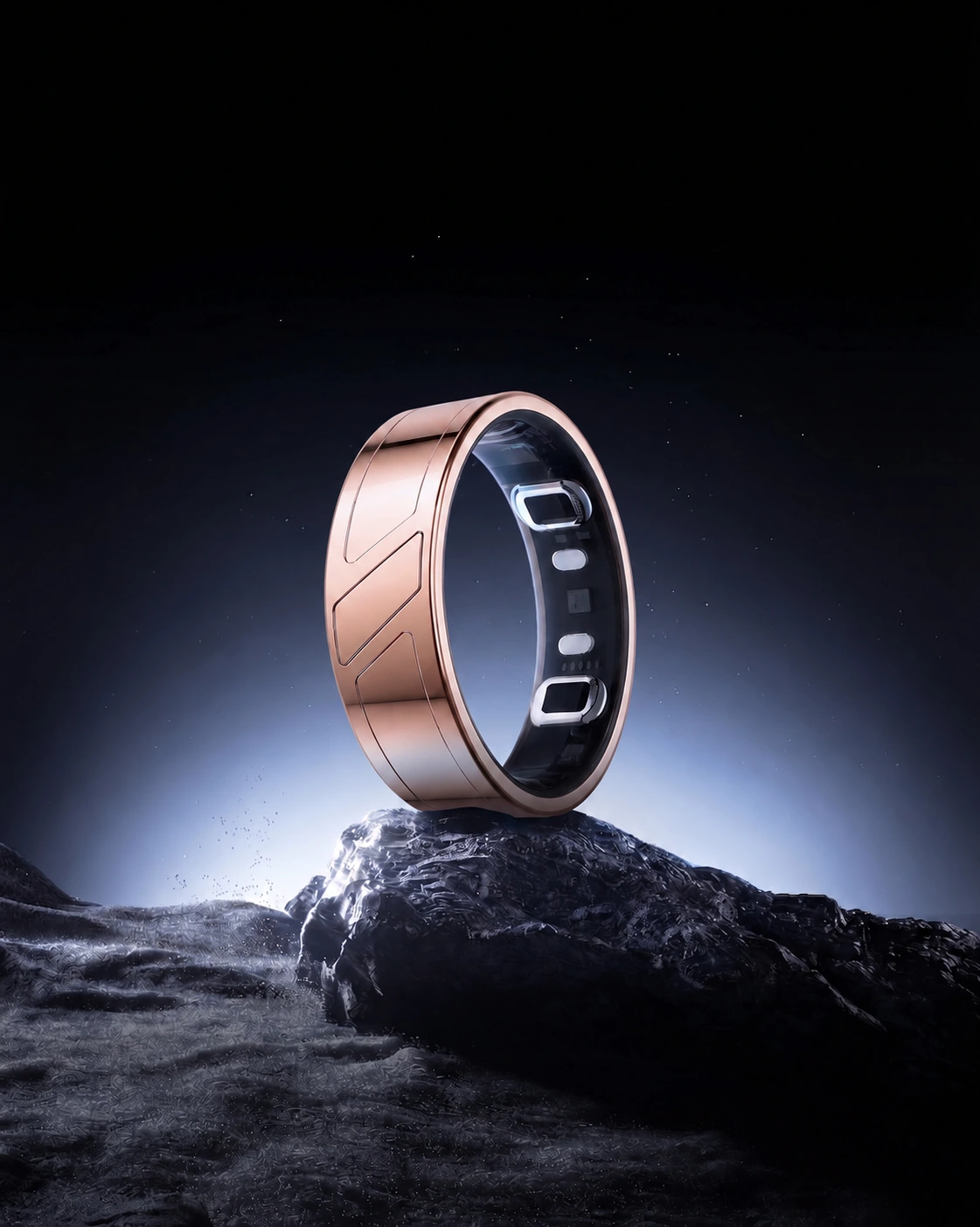
Mere joins this long line as a student, not an inventor. None of the studies above tested Mere's ring or its model. The Mere Ring uses green, red and infrared light to read the shape of your pulse every night: the rise, the peak, the notch and the echo. It also tracks heart rate, HRV, blood oxygen and sleep. For 14 nights it simply learns your normal. Then the Mere app describes what it sees in plain English, as patterns such as Steady, Wired or Drained. The pulse model behind it has been five years in development.
The ambition is an old one, carried by new tools: feel the pulse closely, often and over time, and notice when today differs from your usual. Mere is built for wellness, not diagnosis. The ring notices. Your doctor decides.
If this history speaks to you, join the founding list. Questions are welcome at info@merering.com.
References
- Lewis O. Marcellinus' De pulsibus: a neglected treatise on the ancient "art of the pulse". Scripta Classica Israelica. 2015;34:195-214. doi:10.71043/sci.v34i.2359
- Ghasemzadeh N, Zafari AM. A brief journey into the history of the arterial pulse. Cardiology Research and Practice. 2011;2011:164832. doi:10.4061/2011/164832
- Lewis O. Galen on the pulse: theory and method. In: The Oxford Handbook of Galen. Oxford University Press; 2024:379-416. doi:10.1093/oxfordhb/9780190913687.013.15
- Kumar PVG, Deshpande S, Nagendra HR. Traditional practices and recent advances in Nadi Pariksha: a comprehensive review. Journal of Ayurveda and Integrative Medicine. 2019;10(4):308-315. doi:10.1016/j.jaim.2017.10.007
- Hertzman AB. Photoelectric plethysmography of the fingers and toes in man. Proceedings of the Society for Experimental Biology and Medicine. 1937;37(3):529-534. doi:10.3181/00379727-37-9630
- Quaresima V, Ferrari M, Scholkmann F. Ninety years of pulse oximetry: history, current status, and outlook. Journal of Biomedical Optics. 2024;29(Suppl 3):S33307. doi:10.1117/1.JBO.29.S3.S33307
- Allen J. Photoplethysmography and its application in clinical physiological measurement. Physiological Measurement. 2007;28(3):R1-R39. doi:10.1088/0967-3334/28/3/R01
- Charlton PH, Allen J, Bailón R, Baker S, et al. The 2023 wearable photoplethysmography roadmap. Physiological Measurement. 2023;44(11):111001. doi:10.1088/1361-6579/acead2
- Severinghaus JW. Takuo Aoyagi: discovery of pulse oximetry. Anesthesia & Analgesia. 2007;105(6 Suppl):S1-S4. doi:10.1213/01.ane.0000269514.31660.09
- Kinnunen H, Rantanen A, Kenttä T, Koskimäki H. Feasible assessment of recovery and cardiovascular health: accuracy of nocturnal HR and HRV assessed via ring PPG in comparison to medical grade ECG. Physiological Measurement. 2020;41(4):04NT01. doi:10.1088/1361-6579/ab840a
- Abbaspourazad S, Elachqar O, Miller AC, Emrani S, Nallasamy U, Shapiro I. Large-scale training of foundation models for wearable biosignals. International Conference on Learning Representations (ICLR). 2024. arXiv:2312.05409
Keep reading